


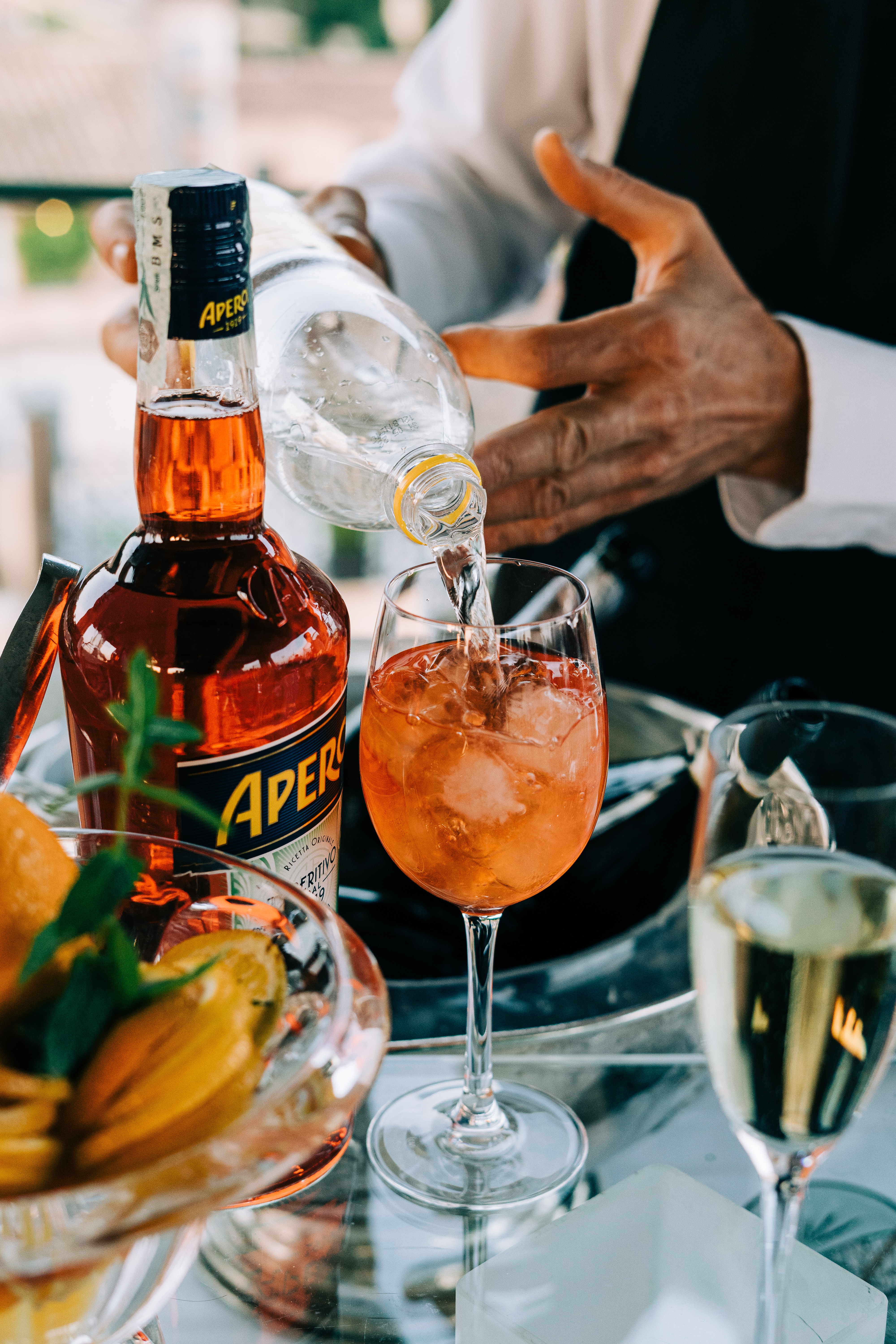
There's something about a hot afternoon that makes you want to be somewhere slower. A café in the Veneto. A sidewalk table in SoHo. A glass of something cold, bitter, and fizzy sweating in your hand.Ice water makes sense. But the spritz feels right and that's a different thing entirely.
The spritz has been around for over a century, shapeshifting through generations of drinkers. These days, when most people picture one, they picture Aperol. That's not an accident. It's the result of one of the smartest brand-building campaigns in modern drinks history. But the cocktail itself? Way more interesting than the marketing.
What’s an Aperol Spritz and Where Did It Originate?
The spritz's origin story begins in 19th-century Veneto, Italy and it starts with outsiders.
Austro-Hungarian soldiers and diplomats traveling through the region found the local wines too heavy for their palates. Their fix: a "spritz" (splash) of soda water to lighten things up. Simple problem, simple solution.
Over time, Italians made the drink their own. Prosecco replaced still wine. Fortified wines, bitters, and amari entered the mix. The spritz became a ritual as much as a recipe, something you had at the end of the workday, with a little something to eat, surrounded by people you liked.
Aperol came onto the scene in 1919, created by brothers Luigi and Silvio Barbieri in Padova. Its low ABV, bright citrus bitterness, and vivid orange color made it a natural fit for the spritz. The combination caught on. By the 1950s, the Aperol Spritz had found its audience: Italians, vacationing Europeans, and Americans looking for a lighter drink after the austerity of the war years.
The drink kept going from there.
What's Behind the Numbers?
Nearly 300,000 Aperol Spritzes are consumed in a single day in the Veneto region alone, according to the Campari Group. Multiply that globally and the number stops being a statistic and starts feeling like a cultural event.
In Q1 of 2022, Aperol sales were up 72 percent year-over-year, led by Italy (up 101.4%), France (up 79.5%), Germany (up 79.2%), and the U.S. (up 51.2%). That kind of growth doesn't happen on its own.
Two things drove it: post-pandemic reopenings and deliberate brand work.
Campari Group CEO Bob Kunze-Concewitz acknowledged to Reuters that stockpiling ahead of inflation accounted for nearly half the increase. But he also pointed to something more durable: the Aperol Spritz had moved beyond the bar. It had become a brunch drink, a dinner starter, an informal occasion all its own.
The "3-2-1" Campaign That Changed Everything
The Campari Group bought Aperol in 2003. Along with ownership came the "official" recipe: 3 parts Cinzano Prosecco, 2 parts Aperol, 1 part soda water. That ratio became a campaign, "3-2-1", and the campaign became a cultural moment.
In Italy, the aperitivo tradition of an end-of-day drink with friends and light bites had been a fixture in the Veneto for decades. The campaign took that ritual and pushed it outward to younger drinkers across the country and positioned it as an affordable, sociable alternative to a heavier night out.
Then Campari exported the idea. In the U.S., a 2018 New York Times piece called it the drink of summer and traced the push directly to Campari America. "We saw there was a growing interest in Aperol in the U.S., especially at summer events and destinations," VP of Marketing Melanie Batchelor told the Times. "We invested behind that."
The investment was targeted: free drinks in the Hamptons, influencer partnerships at summer festivals in Palm Springs, and high-visibility placements at aspirational venues. According to Nielsen, Aperol sales in the U.S. rose 48 percent that year.
The Bigger Shift It's Riding
There's a third factor here, and it's one that predates any marketing campaign.
Drinkers have been moving toward lower-ABV options for years, driven by wellness trends and shifting generational habits. Aperol, at just 11% ABV, lands right in the sweet spot: flavorful and celebratory, without tipping into heavy territory. You can have two with dinner and still feel like a person.
That's not a small thing. It's arguably one of the reasons Aperol's moment has lasted when other "drink of summer" trends fizzled.
The Drink Itself
Bitter. Citrusy. Fizzy. Orange. Some people love it; some people famously do not. But love it or not, it's hard to argue with a drink that tastes like summer, works in any setting, and looks exactly like sunset in a glass.
Whether you're building a back-patio menu or just adding it to your well rotation the canonical recipe has a place on your menu.
The "Official" Aperol Spritz
Ingredients
- 3 parts Cinzano Prosecco*
- 2 parts Aperol
- 1 part soda water
Directions
- Build in a wine glass over large ice cubes (they melt slower and it keeps dilution honest).
- Garnish with a fresh orange slice.
Note: Campari Group owns Cinzano. Any dry prosecco works fine.
Comments